
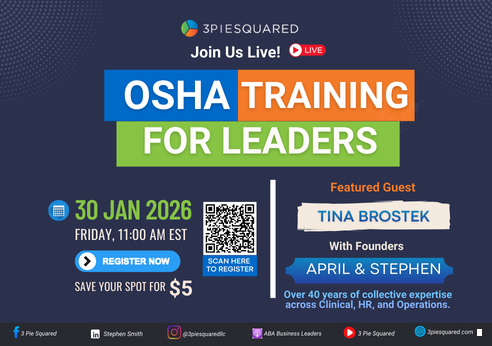
OSHA Training for Leaders
Date & Time: January 30 at 11 AM EST
Duration: 90–120 minutes
Recording: Included, with one year of on-demand access
Join us for OSHA Training for Leaders, a practical, leadership-focused training designed to help ABA leaders understand their OSHA-related responsibilities and proactively manage safety risks across clinic, school, and in-home service settings.
This training goes beyond basic OSHA awareness to address how leadership decisions, policies, and responses directly impact staff safety, client welfare, organizational compliance, and liability.
Why This MattersABA services are delivered in diverse environments that present unique and often unpredictable safety risks. Leaders are responsible not only for client outcomes, but also for ensuring staff work in environments that meet safety, ethical, and compliance expectations.
Even small practices are frequently held to OSHA or OSHA-equivalent standards through payers, insurers, licensing bodies, and accreditation organizations—regardless of whether OSHA ever conducts a formal inspection.
Without clear leadership understanding, documentation, and proactive safety practices, organizations face increased risk of staff injury, burnout, service disruption, denied claims, and liability exposure.
This training equips ABA leaders with the knowledge and tools needed to identify hazards, respond appropriately to safety concerns, and foster a culture of safety and accountability.
Participants will leave with practical leadership tools, including hazard identification strategies, communication frameworks, documentation guidance, and real-world ABA scenarios.
Leaders will gain clarity on how to respond to safety concerns confidently, protect staff and clients, and reduce organizational risk—while modeling ethical, compliant leadership across all service environments.
$5



